Upgrading a 100-Amp Panel to 200 Amps in Sacramento
Thinking about upgrading your old 100-amp panel to 200 amps in Sacramento? Learn costs, SMUD requirements, safety issues, and how overhead vs. underground affects price.
When a “Nasty” Old Panel Needs an Upgrade
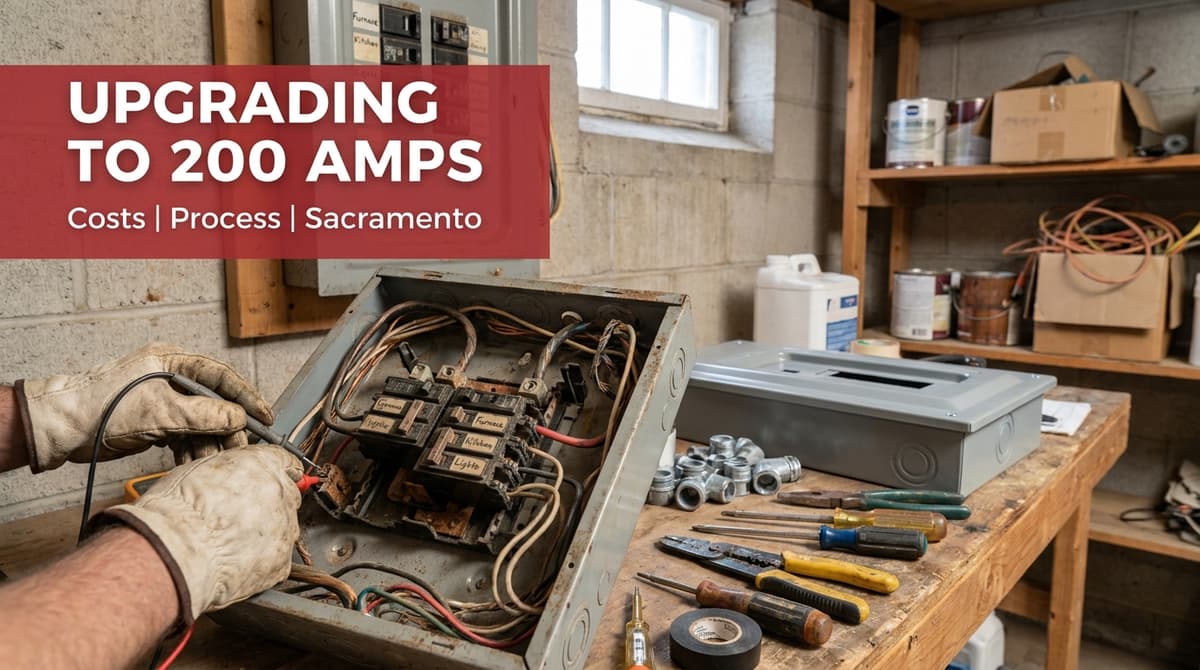
We recently got a call from a homeowner — let’s call him Brian — about a panel replacement in South Sacramento, just off Highway 99 near Mack Road. He told us he had an old Venco “hard hat” panel that “looked pretty nasty,” wasn’t grounded properly, and was only 100 amps. He wanted to upgrade to a 200-amp panel and asked the same question we hear a lot:
“Is this going to be like 10–15K, and are you guys going to have to upgrade the power coming in from the pole too?”
If you’re in Sacramento and you’ve got an aging panel — especially one of those older Venco or Zinsco/FPE-style panels — this is exactly the kind of situation where it’s smart to slow down and understand the costs, the process, and SMUD’s requirements before you dive in.
Why Sacramento Homeowners Upgrade from 100 Amps to 200 Amps
Brian’s panel had two big strikes against it: it was old and undersized. A 100-amp panel was fine decades ago, but today’s homes usually need more capacity, especially if you’ve added:
- Central air conditioning or a heat pump
- Electric vehicle chargers
- Electric ranges, dryers, or tankless water heaters
- Hot tubs or backyard studios/shops
On top of that, many of the old Venco-style panels we see around Sacramento have poor grounding, double-tapped breakers, and signs of overheating. Brian had already noticed his grounding was suspect just by looking at it — and he was right to be concerned.
From our side of the fence, we consider a 200-amp upgrade when any of the following are true:
- You’re tripping breakers often when you run multiple big appliances.
- The panel is visibly rusted, damaged, or feels warm/hot to the touch.
- There’s no main breaker, or the labeling is a mess.
- It’s an older “problem brand” panel that inspectors and insurers don’t like.
Overhead vs. Underground: Why It Matters for Cost
One of the first things we asked Brian was whether his service was overhead (wires from a pole to a weatherhead) or underground (fed from a ground-level utility box). At first he wasn’t sure — like many homeowners — but then confirmed it was underground.
That one detail tells us a lot:
- Overhead service is usually simpler and more straightforward. We replace the panel, coordinate with SMUD for the overhead line reconnect, and in many cases they’ll upgrade their side of the service drop at no additional cost if the cable is outdated.
- Underground service can be more involved. We have to consider the distance to the SMUD transformer or pedestal, the condition and size of the existing underground conductors, and whether new conduit or trenching is needed.
In Brian’s case, the service being underground meant we needed a site visit before tossing out any “for sure” numbers. From the outside, an underground upgrade can look like the same job as an overhead one — but behind the scenes, the labor and coordination can be very different.
Typical Cost Range for a 200-Amp Panel Upgrade in Sacramento
When Brian asked if he should budget around $10k–$15k, we gave him the same honest answer we give everyone: “It depends.” That’s not a dodge — there are a few major factors that swing the price up or down:
- Overhead vs. underground service and distance to the utility point
- Condition of existing wiring inside and outside the panel
- Location of the panel (accessible exterior wall vs. awkward interior spot)
- Required upgrades like new grounding, bonding, or relocating the meter/main to meet current code
For a straightforward overhead upgrade in Sacramento, we often see total project costs land in the mid-to-high four figures, sometimes nudging into the low fives when there are extras (subpanel work, EV-ready circuits, etc.). Underground service, trenching, or longer conduit runs can push things toward that $10k–$15k range Brian mentioned.
Our approach is always to visit the property, take detailed photos, and walk you through the estimate step-by-step so you know exactly why the number is what it is — not just a lump sum on a piece of paper.
How SMUD Fits Into Your Panel Upgrade
Because Brian’s home is in SMUD territory (not PG&E), the coordination process is a bit more homeowner-friendly. SMUD is generally very good about:
- Upgrading older overhead service drops when you upgrade your panel
- Working with licensed electricians on scheduled disconnect/reconnects
- Inspecting and verifying the new meter/main setup
Here’s the simplified flow we typically follow for a SMUD-served 200-amp upgrade:
- Site visit and evaluation – We inspect the panel, grounding, meter location, and service type (overhead/underground), then take photos and measurements.
- Design and estimate – We size the new panel, plan conduit routes, grounding upgrades, and any relocation required to satisfy current SMUD and code requirements.
- Permits and SMUD coordination – We pull the electrical permit with the city/county and schedule the SMUD shutdown and reconnect window.
- Panel replacement day – We remove the old panel, install the new 200-amp meter/main, update grounding and bonding, and make up all connections to current code.
- Inspection and power restore – The inspector signs off, SMUD reconnects, and we walk you through the new panel labeling and operation.
Safety Issues We See With Aging Panels
Brian mentioned that his panel wasn’t even grounded properly, which is something we see all the time in older Sacramento homes. Common problems include:
- Missing or loose grounding electrodes (ground rods or UFERs) or undersized grounding conductors
- Double-tapped breakers where two circuits share a breaker not designed for that
- Corrosion and rust from years of weather exposure or water intrusion
- Overheated breakers or bus bars from long-term overloading
Any of these can be a real fire and shock hazard. Upgrading the panel isn’t just about “more power” — it’s also about bringing the heart of your electrical system up to modern safety standards.
How Long Does the Process Take?
Another question we get from Sacramento homeowners is timing — especially if the property is vacant, like Brian’s, or if you’re trying to coordinate around tenants or remodel work.
In general, you can expect:
- 1–2 weeks for design, permitting, and SMUD scheduling (sometimes quicker, sometimes slower depending on the season and jurisdiction).
- 1 full workday for the actual panel swap, grounding upgrades, and cleanup.
- Same-day or next-day inspection and SMUD reconnect in many cases, if everything is scheduled properly.
We always keep you in the loop with appointment confirmations and “on our way” notifications, just like we did for Brian. Whether you’re on-site or the property is vacant, we document everything with photos so you can see exactly what was done.
Quick Checklist Before You Call for a Panel Upgrade
If you’re thinking about upgrading your 100-amp panel to 200 amps, here are a few things you can check ahead of time to make the first visit smoother:
- Look outside and note whether power comes from a pole overhead or from a ground-level box (underground).
- Take a few clear photos of the panel, inside and out, plus the meter and surrounding wall area.
- Make a list of any future loads you’re planning: EV charger, hot tub, ADU, solar, new HVAC, etc.
- Note any frequent tripping of breakers or outlets that feel warm or discolored.
You don’t have to diagnose anything yourself — that’s what we’re here for — but having this info handy helps us give you a more accurate idea of scope and cost right from the start.
Thinking About Upgrading Your Panel in Sacramento?
Brian did the right thing by calling as soon as he realized his old Venco panel was in rough shape and poorly grounded. Whether you’re dealing with the same kind of panel, constant breaker trips, or you’re planning for more electrical demand, a properly sized 200-amp panel that meets SMUD and code requirements is one of the best long-term investments you can make in your home’s safety and usability.
If you’re in the Sacramento area and wondering what a panel upgrade would look like for your particular home, we’re happy to come out, take a look at the whole scope of work, and walk you through an honest, transparent estimate — no pressure and no surprises.